Set Yourself on Fire (And Put it Out Before You Hurt Someone)
28 July 2025… It’s about eighty miles north and 4,000 feet up from Phoenix to Payson. Phoenix bakes in a bowl of bare earth rimmed with low mountains. Payson sits up on a piney nape where geological formations (or, in yeoman parlance, mammoth rocks) called the Mogollon Rim, Mazatzal Mountains, and the Granite Dells all come together. It was 105 degrees when I stopped at a Wendy’s on the outskirts of Phoenix, munched on a baked potato, chugged a couple liters of cold water, and soaked my clothes in the bathroom sink. At about 1 pm I rode my motorcycle out into the saguaro-dotted desert. July afternoons out here lie burnt and spread-eagled beneath the militant sun, blowing through you dull and mean, stealing the water from your skin and guts, leaving you bleached as a bone.
That kind of heat is alive. It rises up from the scorched earth and settles down atop the parched crust like a great, hot, living embrace. I rode away from Phoenix’s soulless sprawl with the sense I was escaping something comfortable but contrived. Air conditioning, chlorinated pools. Safety and security. And I was rushing into the flaming arms of the desert. Every so often I guess you’ve got to set yourself on fire to know you’re alive.
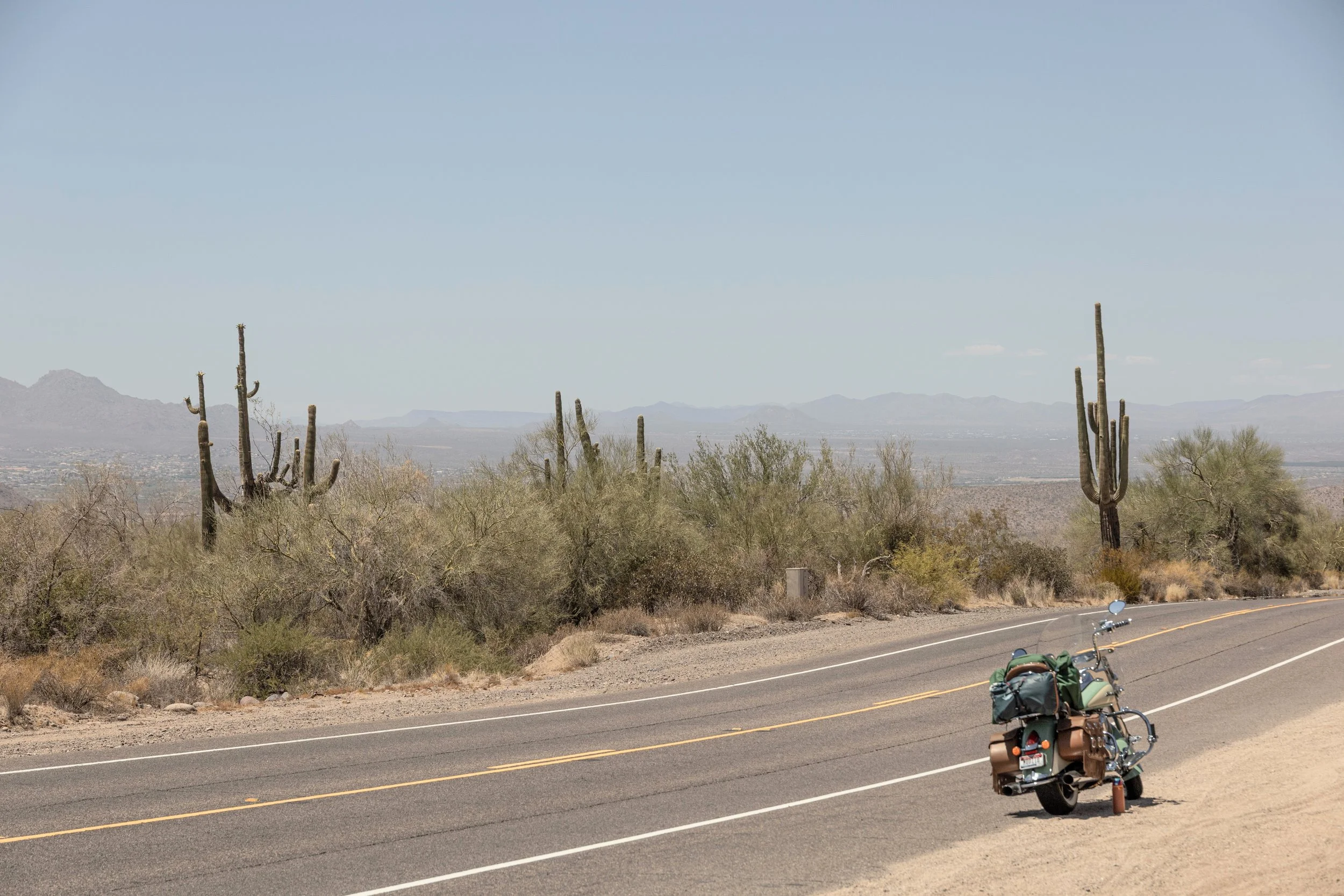
Usery Pass Road, just outside Phoenix.
Two hours later it was ninety-eight degrees in Payson, which felt downright pleasant. I parked my bike outside the Buffalo Bar & Grill in the shade of a tall pine tree. Although not a chain restaurant, the grill felt like a standard issue, western-themed eatery: everything was made of wood and the walls dripped with cowboy hats, lassoes, and kitschy wall hangings that said vaguely sexist things like, “Scariest thing a man ever said — ‘Yes, dear!’”
It was 4 pm on a Monday. A smattering of older men in polos perched on barstools, looking more like they’d just rolled in from a credit union than a cattle drive. A bald white guy with a long, pointy beard made me think of a white supremacist Gandolf, but he was quietly discussing cryptocurrency with a couple Hispanics in workboots and baseball caps with sharply rounded bills who spoke in accentless English, so I guess first impressions can be wanting. I had a steak and a substantial green salad, accompanied by really loud country music, which I didn’t mind that much, maybe because my ears were still on fire a little.
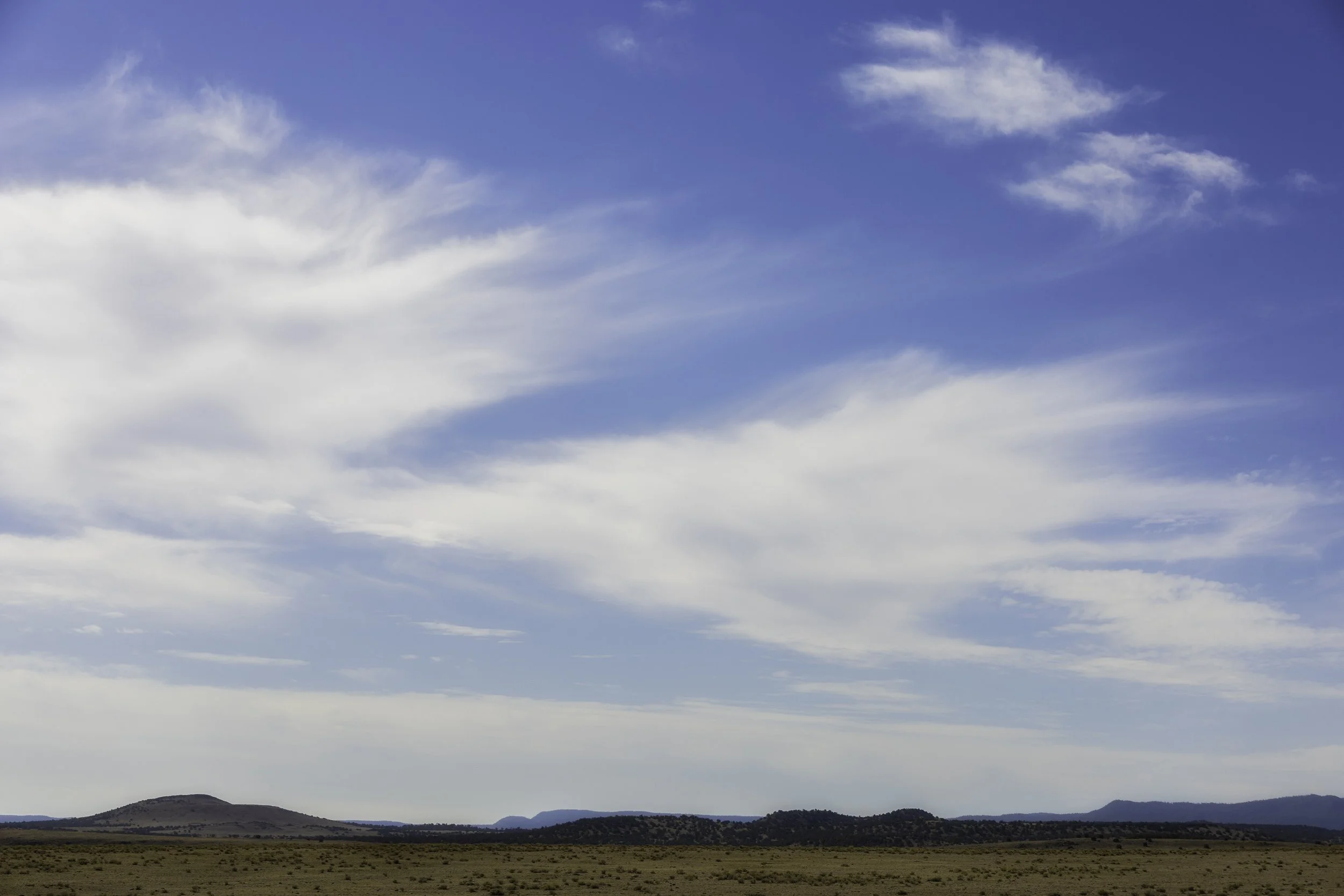
The view from Pie Town, New Mexico.
The next morning I was standing in the shade of a Circle K in a speck of a town called Eagar, spooning processed peaches from a plastic cup into my mouth. Eagar looks like it fell off the 9,000 foot plateaus of the White Mountains to the south and landed on its face in the high scrub 15 miles west of the New Mexico border. Three Mormon pioneers founded Eagar in the 1870s and my new friend Mel was not very happy about that fact.
Mel was a fit, thin man in his 80s with blue eyes, a close-cropped white beard, and feet stuffed into an worn pair of Tevas. He gassed up his old Subaru, bought a Big Gulp and a turkey stick inside, and then stopped to talk to me about motorcycles. “I used to have a damn nice bike, till the sheriff’s son stole it out of my front yard,” Mel told me. I said, “How do you know it was him?” Mel said, “Because I told his daddy he stole my bike and he wouldn’t do anything about it.” I’m not an investigative journalist, so I asked no further questions even though I had plenty. Mel was just getting started though. “It’s because everyone in this town is a damn Mormon,” he complained. “They all protect each other.” Unable to deal with Eagar’s Mormons, Mel moved about an hour east to Pie Town, New Mexico, bumping its population up to 186. “I’ve got 10 acres. It’s quiet. I can see the stars. I feel alive out there.”
Mel stopped talking, looked at the blue sky, exhaled. He sized me up. “You ain’t Mormon, are you?” I smiled politely and said, “I am, but no offense taken.” This pleased Mel. “You’re alright. You ain’t like the others,” he said, which I guess is how people resolve the dissonance that springs from adopting sweeping judgments about out-groups and then actually meeting members of those out-groups and finding them resoundingly agreeable. I found this man breathtakingly narrowminded, refreshingly friendly, infectiously energetic, occasionally thoughtful, and maddeningly simple. And I found myself simultaneously insulted and inspired for reasons that don’t need to make sense to make good. I just said, “Thanks Mel,” and I meant it. There are other things I could’ve said. But I didn’t say them. Instead I stood there shaking Mel’s hand and he fixed me with his blue eyes and said he was glad we met. And so was I. Every so often I guess you’ve got to put out the fire to know you’re alive.