
Ode to Now (or, "A Pretty Face, Time and Space, and Schrödinger's Grace")
One night I wedged myself into a scab-colored Ford Taurus with seven other 18 year olds to attend a concert headlined by Counting Crows and the Wallflowers. I assure you that liking these bands unironically was acceptable in 1997. They were cooler than Matchbox 20, but just barely, and less cool than Fugazi, by a lot. A known Fugazi fan spotted at this concert would have been drug into a Salt Lake City alleyway and given a spirited reeducation lecture about artistic integrity, record label indecency, and the physical and moral dangers of slam dancing.
We were eight overgrown adolescents occupying a 5-seater. We drove on the freeway, well beyond freeway speeds. We did this because we were young and free and unable to accurately assess risk and because driving the speed limit at that age was almost as socially perilous as open enthusiasm for Magic: The Gathering tournaments. I was one of two people in the passenger seat. A cute girl in overalls sat on my lap, hunched up beneath the car’s low ceiling, her head bent down almost level with mine. Her knee blocked fourth gear so that the driver had to redline it in third and then jump straight to fifth.
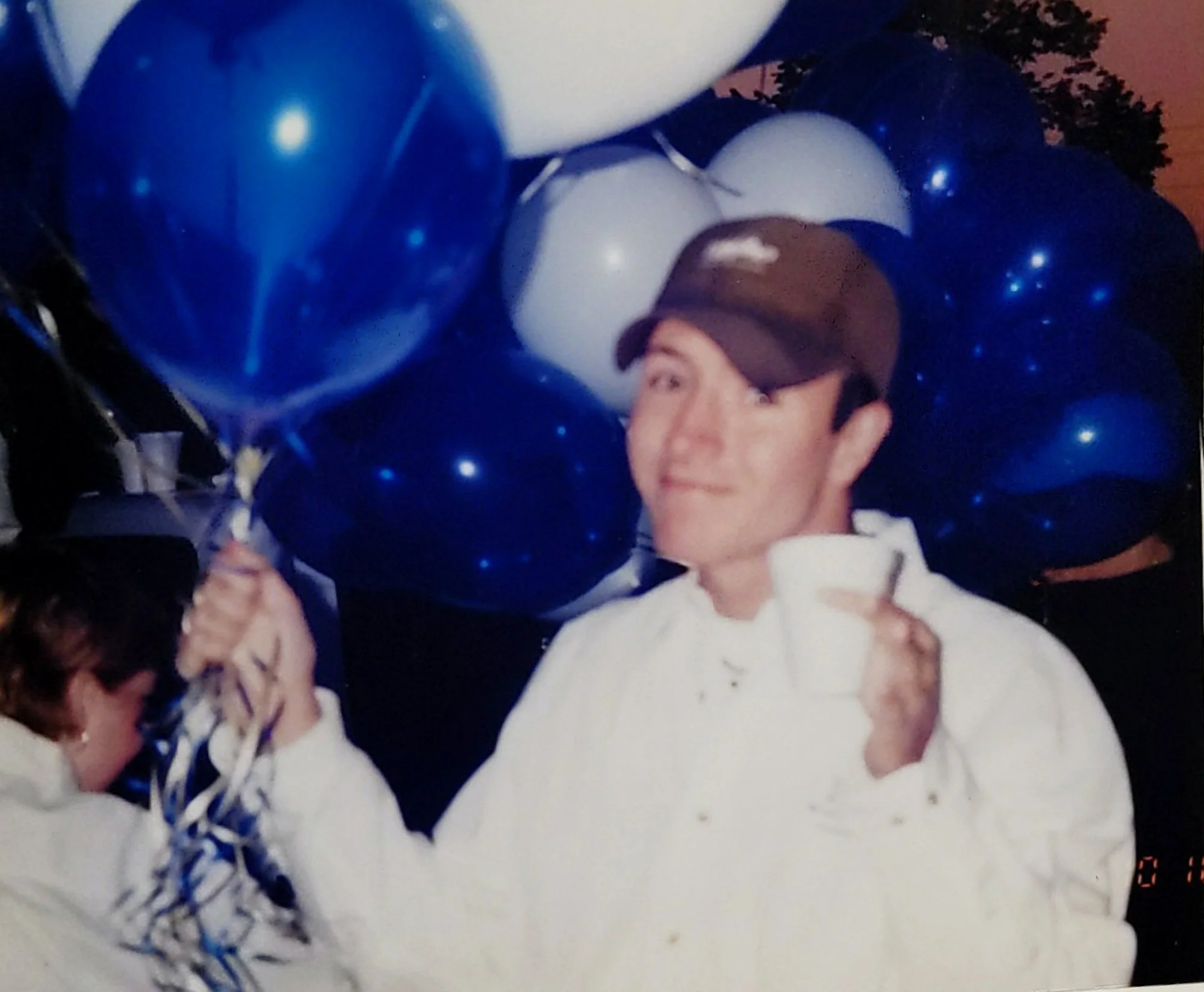
Wannabe Fugazi fan. (11 October 1997, a few weeks after the concert in question)
Someone threw Achtung Baby in the CD player. “One” came through the car speakers. It is famously not a love song, but that fact was crushed beneath the sensation that this singular blip in time was inevitable and constructed precisely for us, flying in the cabin of an ugly car on a pretty night. It seemed like the most normal thing in the world for me to sing along softly to U2, and I somehow wasn’t surprised at all when the girl in my lap started singing quietly too. We get to carry each other, we breathed. I knew this girl only slightly better than I knew the cashier at the campus Taco Bell, with whom I had interacted thrice, and whose name was Ashley, or possibly Gerald. Yet it weirdly was not awkward that we were singing directly into each other’s faces. This was natural. It was written.
All of this probably happened, more or less. Probably less, if I'm being honest. It’s been a second since that night. More accurately, it’s been 400 million seconds. I don’t actually remember if we drove a Ford Taurus, nor what color it was. I know “One” was on the stereo, but there's only an 80 percent probability it was a CD. It’s 15 percent possible it was playing on the radio, and there is a vanishing chance we were hearing a cassette tape. Cassette tapes in 1997 were like Oscar the Grouch: they were comfortable and reminded you of simpler times, but they sounded kind of annoying and mostly lived in trash cans.
The internet was a baby and phone cameras didn’t exist, but if they did then I guess shaky videos and poorly-composed wide-angle photos would bring all the empirical elements of that car interior and the people in it hurtling back through time, rendering moot everything between then and now. But technology could only tell us the facts of that night, and the facts don’t matter that much. What matters about that night is not whether the girl smelled like lavender or vanilla, or how the reflected dashboard lights danced across the curve of her cornea. What matters about that night, and what zeros and ones and data centers in middle America cannot capture or contain, is the way it felt. That woozy electricity that buzzes in your blood when you're that close to something that beautiful, and you know in a deep place it will be over and lost the instant after it happens, and there’s nothing you can do about it.
The night of that decent but unspectacular rock concert is gone, buried by time piling up on itself. Audiovisual record of those hours, even if it existed, could not exhume them, because as soon as they happened they collapsed into now. The present is everything and the only thing. This is because events that already occurred are inert on their own. They cannot animate themselves. They can only be accessed remotely from the here and now, and only the here and now can infuse them with any meaning. The past is a star that implodes the instant you leave it.
It was a fine time in a speeding vehicle on an autumn evening when we burned wild and reckless in a pulsing ball of nuclear fusion, eighteen years old and flying down the freeway with nothing to do but live. Then it cooled the instant it passed, it folded inward and annihalated itself. If I squint enough I can still catch flecks of light from that long-dead fine time, light that has been traveling for decades to reach me. And when I see it, it doesn’t look like anything at all. But it still feels like something, like when you have a good thing and then it’s gone, and you realize that remembering it is better than living it. Sometimes the hole where the star used to be is brighter than the star ever was.
This is occasionally untrue, however. Sometimes the star is so bright it cannot collapse, it just stays and stays and stays, defying the alleged laws of spacetime that I pronounced over the preceeding three paragraphs, having considered the matter for twenty minutes without consulting the work of actual experts in the field. I have a law degree though, so I am in fact versed in spacetime’s relationship with torts, which seems irrelevant, but still. Nevertheless, here is an example of when the laws of spacetime distort.
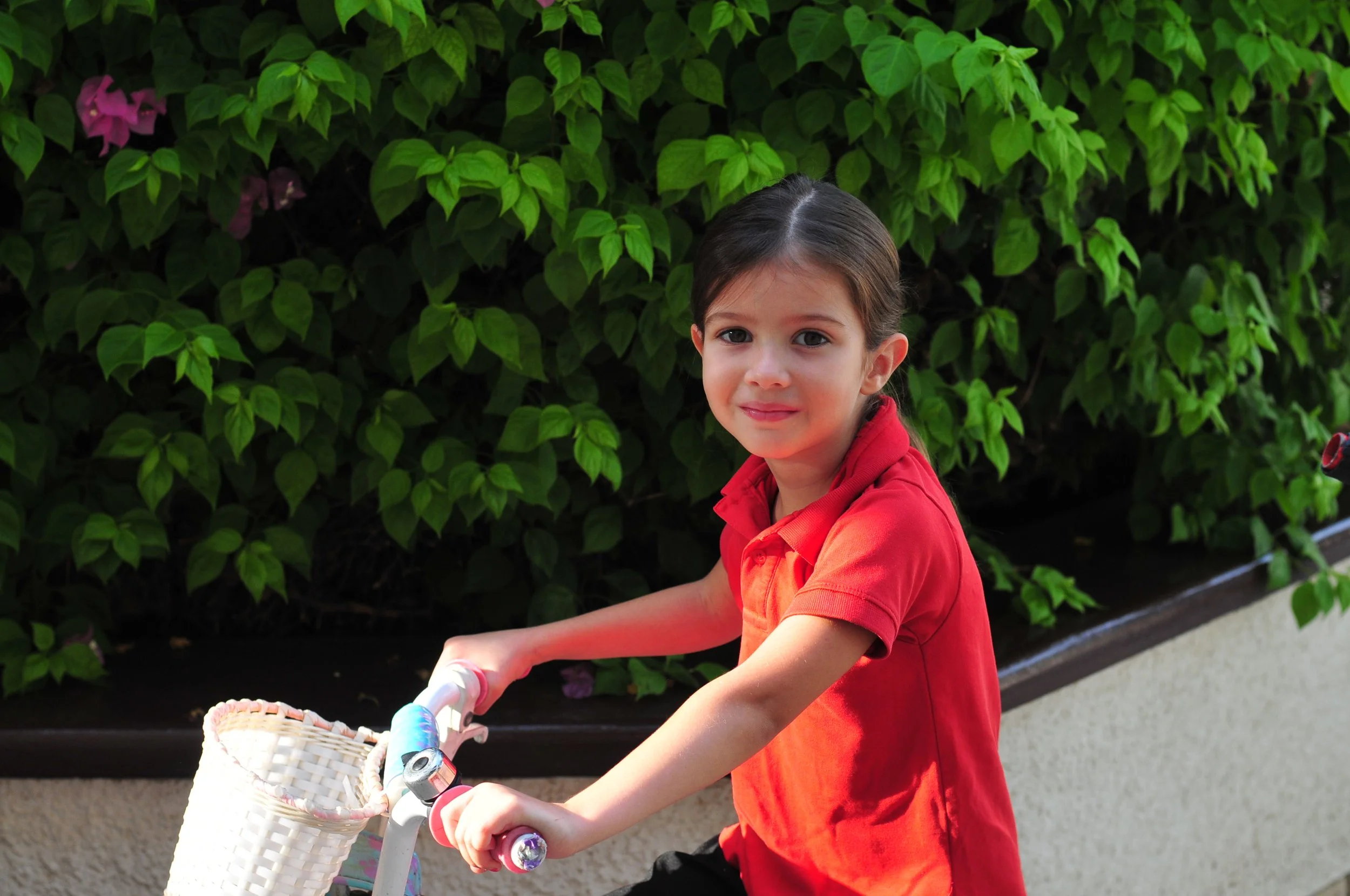
In the market for a biker gang. (March 2013)
When my kids were small we lived on a housing compound in Saudi Arabia. I used to walk them to school, and once as we left the house I announced, “I get to hold Grace’s hand on the way to school today!” Grace was in kindergarten and had just learned to ride a bicycle. She said, “But if I hold your hand on the way to school then I can’t ride my bike.”
“Ah, yes,” I said. “That’s right. It’s okay then, Grace. You should go ahead and ride your bike. I’ll just walk along beside you.” Grace looked up at me, smiled a little smile, and her miniature hand squeezed mine. “No,” she said breezily. “I’ll walk today.” So we held hands all the way to school.
That morning should be gone, obliterated by the force of 400 million seconds imploding one after the other since Grace and I were stars on a street in the sun on a spring day in the desert. But it is not gone. When I recall that snatch of time, I am somehow not accessing it from the present, imbuing it with meaning conjured in the here and now and projected onto the past. Rather, I am inside it. It is as if Grace and I are then and now simultaneously, here and there concurrently. Call it Schrödinger’s Grace. She is a little girl walking beside me with little strides, she’s a grown woman too busy to call home. I’m an aging man with aching joints, a young dad holding a small hand, a teenager on a heady night soaring to a mediocre concert. We are all here now. We get to carry each other.
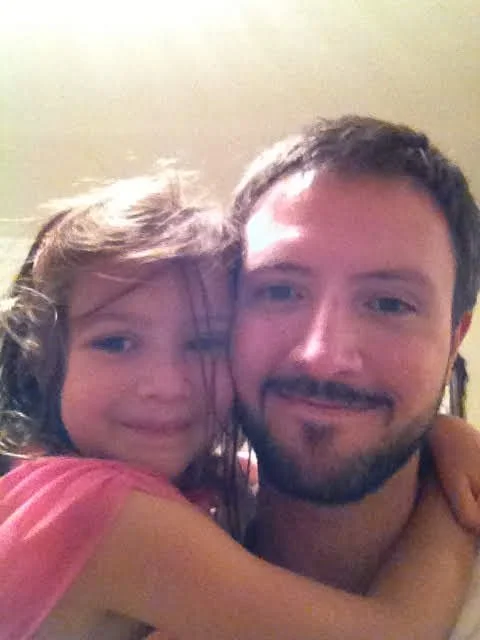
Carrying each other. (September 2013)